
Updated October 2, 2026, using the Louisiana Supreme Court’s 2025 annual report.
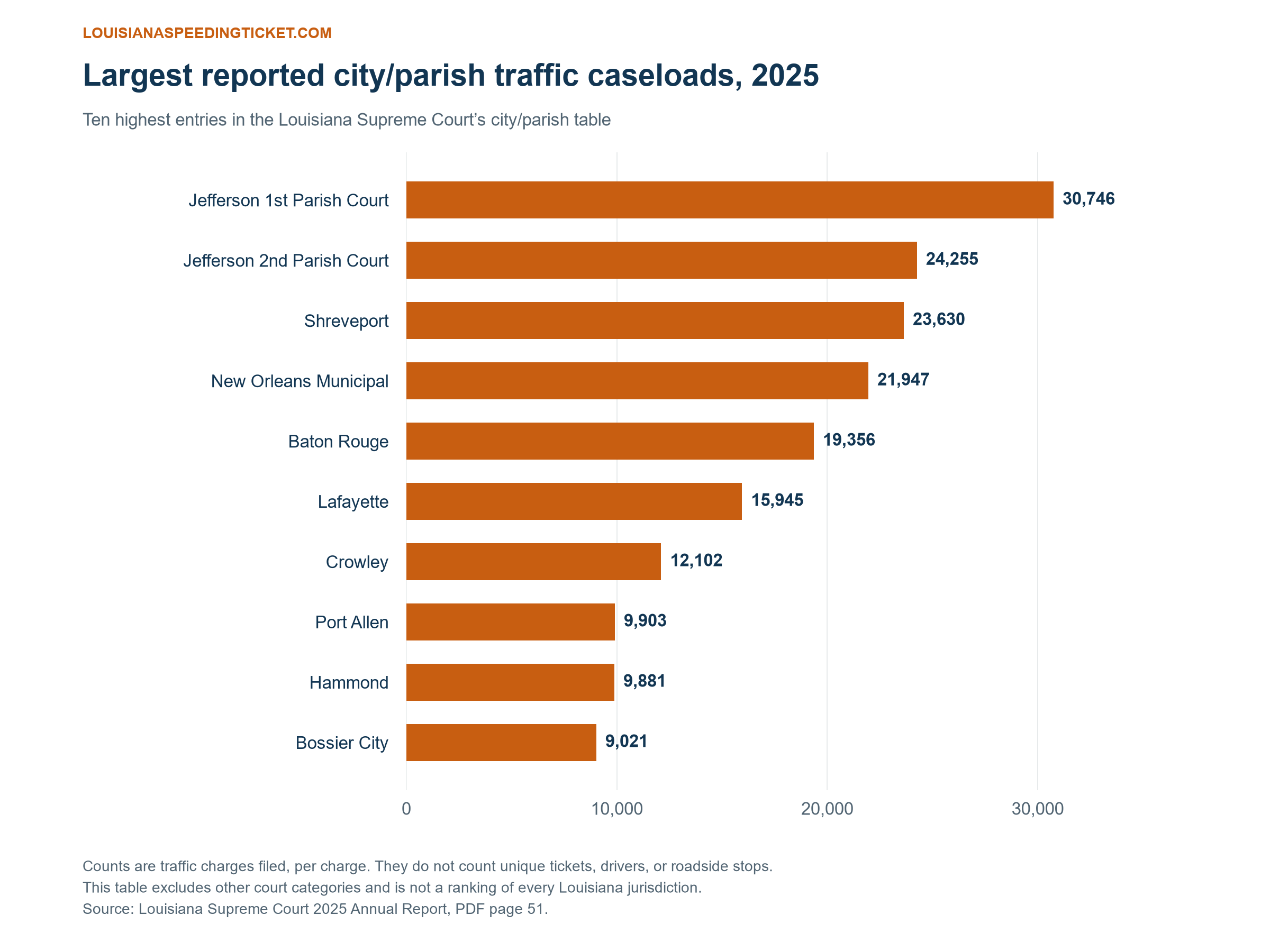
Which Louisiana courts report the most traffic-ticket activity? In the 2025 city and parish court table, Jefferson First Parish Court reports the largest number of traffic charges filed: 30,746. Jefferson Second Parish Court follows with 24,255, and Shreveport City Court reports 23,630.
These are court filings, not a ranking of police-issued tickets or unique drivers. The report expressly counts the city/parish traffic category per charge. One citation can contain more than one charge, and a filing can occur after the roadside encounter. The distinction is essential before using the figures to describe enforcement.
The ten largest reported city/parish traffic caseloads
The following ordering comes from the Traffic Filed column on page 51 of the 2025 annual report. It ranks the entries within that table, not all types of Louisiana courts combined.
Download the source table (CSV) · Download the chart (PNG)
| Court entry | 2025 traffic charges filed |
|---|---|
| Jefferson First Parish Court | 30,746 |
| Jefferson Second Parish Court | 24,255 |
| Shreveport | 23,630 |
| New Orleans Municipal | 21,947 |
| Baton Rouge | 19,356 |
| Lafayette | 15,945 |
| Crowley | 12,102 |
| Port Allen | 9,903 |
| Hammond | 9,881 |
| Bossier City | 9,021 |
The table’s statewide traffic-filed total is 286,634. Jefferson’s two parish-court entries together account for 55,001, or approximately 19.2% of that particular total. That is a calculated share of reported city/parish traffic charges, not Jefferson Parish’s share of all Louisiana citations.
District court figures tell another part of the story
The report separately lists district-court traffic filings by parish. These five parish rows have the highest reported 2025 traffic-filed counts in that district-court table. They should not be substituted for complete parish citation totals: traffic matters can also be handled in other courts.
| District-court parish row | 2025 traffic filings |
|---|---|
| Ouachita — 4th Judicial District | 25,114 |
| St. Charles — 29th Judicial District | 22,836 |
| St. Tammany — 22nd Judicial District | 15,640 |
| East Baton Rouge — 19th Judicial District | 15,149 |
| Evangeline — 13th Judicial District | 12,508 |
The district-court table reports 270,930 traffic filings in total. Adding its total to the city/parish table yields 557,564 reported traffic filings across those two tables. That arithmetic does not produce a statewide count of unique citations: it does not deduplicate cases or drivers and does not include every court or administrative process.
The city/parish total fell, but local entries moved differently
The 2024 report lists 299,200 city/parish traffic charges filed. The 2025 total of 286,634 is 12,566 lower, a decline of approximately 4.2%. That agrees with the 2025 report’s summary.
| Reported city/parish entry | 2024 filed | 2025 filed | Calculated change |
|---|---|---|---|
| Shreveport | 19,471 | 23,630 | +4,159 (+21.4%) |
| Baton Rouge | 49,179 | 19,356 | −29,823 (−60.6%) |
| All entries in the table | 299,200 | 286,634 | −12,566 (−4.2%) |
Baton Rouge’s large reported decline warrants a closer look at the underlying court records and reporting practices before attributing it to an enforcement change. Shreveport’s increase likewise cannot establish an officer quota or a change in the number of unique motorists stopped. The annual tables describe the reported caseload, not the cause of a change.
Why another statewide figure is larger
The 2025 report also says the Court Case Management Information Systems division received 679,423 traffic citation records and added 142,275 qualifying records to the OMV official driver-record database. That section describes an electronic reporting program transmitting final disposition information. It measures a different process from new case filings.
Do not treat 679,423 as proof that that many new roadside tickets were issued in 2025, or describe the difference between received and OMV-added records as dismissed tickets. Qualification for driver-history reporting and disposition reporting are different from the issuance of a citation.
What this comparison leaves out
- The city/parish ranking does not include the many municipal mayor’s courts as separate entries.
- The tables do not identify an issuing officer, road, date of stop, or driver’s home state.
- DWI appears in the criminal category under the report’s notes, rather than supplying a complete count in the traffic column.
- Administrative camera notices and parking matters should not be assumed to be included in ordinary traffic-court filings.
- Counts do not measure the number of trips or vehicles travelling through each jurisdiction, so they are not a rate of tickets per driver.
For example, New Orleans Municipal and Traffic Court expressly says it does not handle camera or parking tickets. Its annual traffic-court count therefore should not be advertised as all notices issued by New Orleans. Similarly, a small town’s fine revenue cannot fill a missing citation count by dividing dollars by a guessed ticket price.
Use the statistics for context, the citation for your case
The annual report provides a useful, reproducible view of where Louisiana courts report substantial traffic caseloads. It does not decide whether an individual ticket is valid, what its total amount is, or whether an appearance is required. Read the court, charge, and deadline on the actual citation.
If you want help reviewing a Louisiana traffic ticket, send our team the citation and any later notice. For the financial side of enforcement, our updated Fenton research explains why fine revenue, fund scope, and audit qualifications require separate analysis.
Sources checked October 2, 2026. Rankings use the published 2025 traffic-filed columns; percentage changes are our calculations from the cited 2024 and 2025 reports. No result is presented as a count of every unique citation issued statewide.